Emissions Testing for Construction and Field Service Fleets in Atlanta: The Complete Guide
A construction or field service business doesn’t run its vehicles from a single central lot as a dealership or delivery depot does. Trucks and vans are scattered across job sites, technician homes, and worksites all over metro Atlanta on any given day. That structure makes emissions testing genuinely harder to manage than for a fleet that starts and ends every day in the same place. In Georgia, most gasoline work trucks and vans still need an annual emissions test to stay registered, and for a business built around HVAC, plumbing, electrical, landscaping, or general contracting work, fitting that requirement around a scattered, job-driven schedule takes real planning.
This guide covers what construction and field service businesses in Atlanta need to know about emissions compliance, why a decentralised fleet makes this harder than a typical operation, and how on-site testing keeps trucks working instead of sitting at a station.
Why construction and field service fleets are structured differently
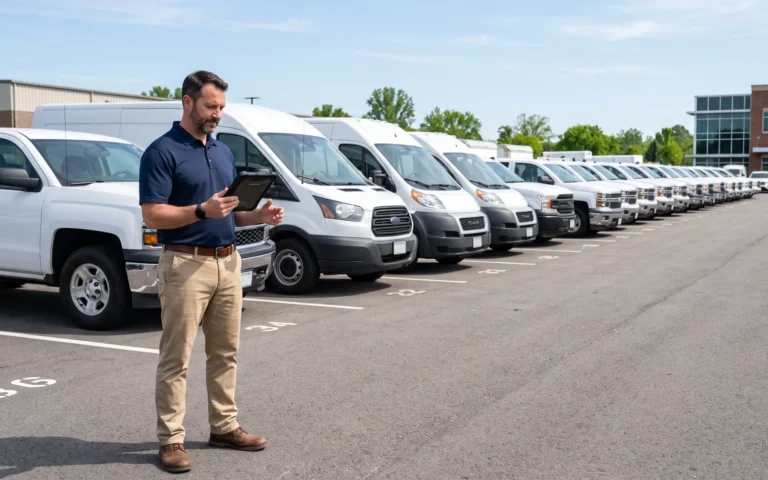
Most fleets fall into one of two patterns. Either every vehicle returns to a central lot or depot each night, or vehicles run fixed routes from a single starting point. A field service or construction fleet often does neither. A technician might drive a company truck home at night, head straight to a job site the next morning, and never pass through a central lot at all during the work week. Multiply that across a team of technicians, each with an assigned vehicle, and the fleet becomes genuinely decentralised.
This structure means the whole fleet is rarely in one place at the same time, which is exactly what a typical testing approach would rely on. Coordinating testing across a fleet like this takes a different kind of planning than gathering vehicles at a depot.
Which vehicles need testing
Most gasoline trucks, vans, and cars registered in the 13-county Metro Atlanta emissions region need to pass an annual emissions test before registration can be renewed. For a construction or field service fleet, this generally includes most gasoline-powered work vehicles. A few categories are exempt:
- The three newest model years, a window that shifts forward every year
- Vehicles 25 model years old and older
- Diesel-powered vehicles, common among heavier construction trucks and equipment hauliers
- Fully electric vehicles
Because construction and field service fleets often mix heavier diesel trucks with lighter gasoline vans and pickups used by individual technicians, the exempt share of the fleet can vary more than in a fleet made up of a single vehicle type. Knowing exactly which trucks in a mixed fleet need testing avoids wasted effort chasing exemptions that don’t apply.
The cost of pulling a technician’s truck off the job
For a business where each vehicle is assigned to a specific technician, taking a truck out of service does not just remove a vehicle. It also removes that person’s ability to work that day. A plumber, electrician, or HVAC technician without their truck cannot reach job sites, carry tools and parts, or complete scheduled appointments. A single vehicle sent to a testing station can mean a missed service call, a rescheduled customer, or a full day of lost billable labour for one team member.
Across a team of a dozen or more technicians, each with their own vehicle and their own testing renewal date, the disruption becomes a recurring management headache rather than an occasional inconvenience.
Why a decentralised fleet makes traditional testing harder
Testing a centralised fleet is straightforward in theory: gather the vehicles, test them, done. A decentralised field service fleet does not offer that option. Vehicles are wherever the day’s jobs take them, and pulling one aside for testing means either interrupting a scheduled job or asking a technician to make a special trip on their own time, both of which cost the business in different ways.
This is where many field service businesses end up managing testing reactively, scrambling to fit in a station visit whenever a renewal notice arrives, rather than handling it proactively as part of normal operations.
How on-site testing fits a construction or field service business
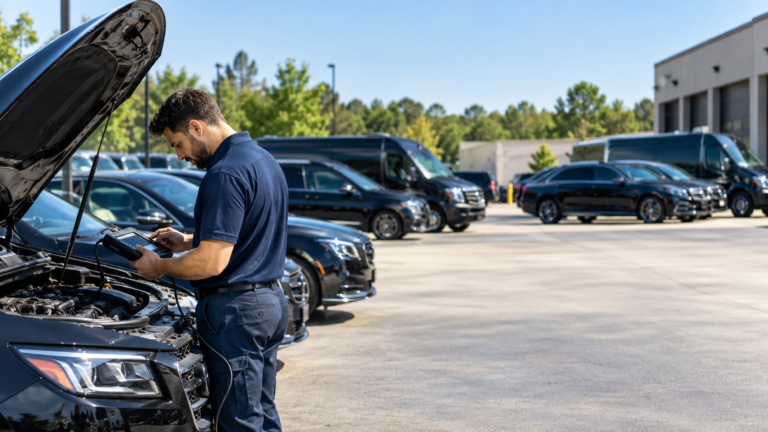
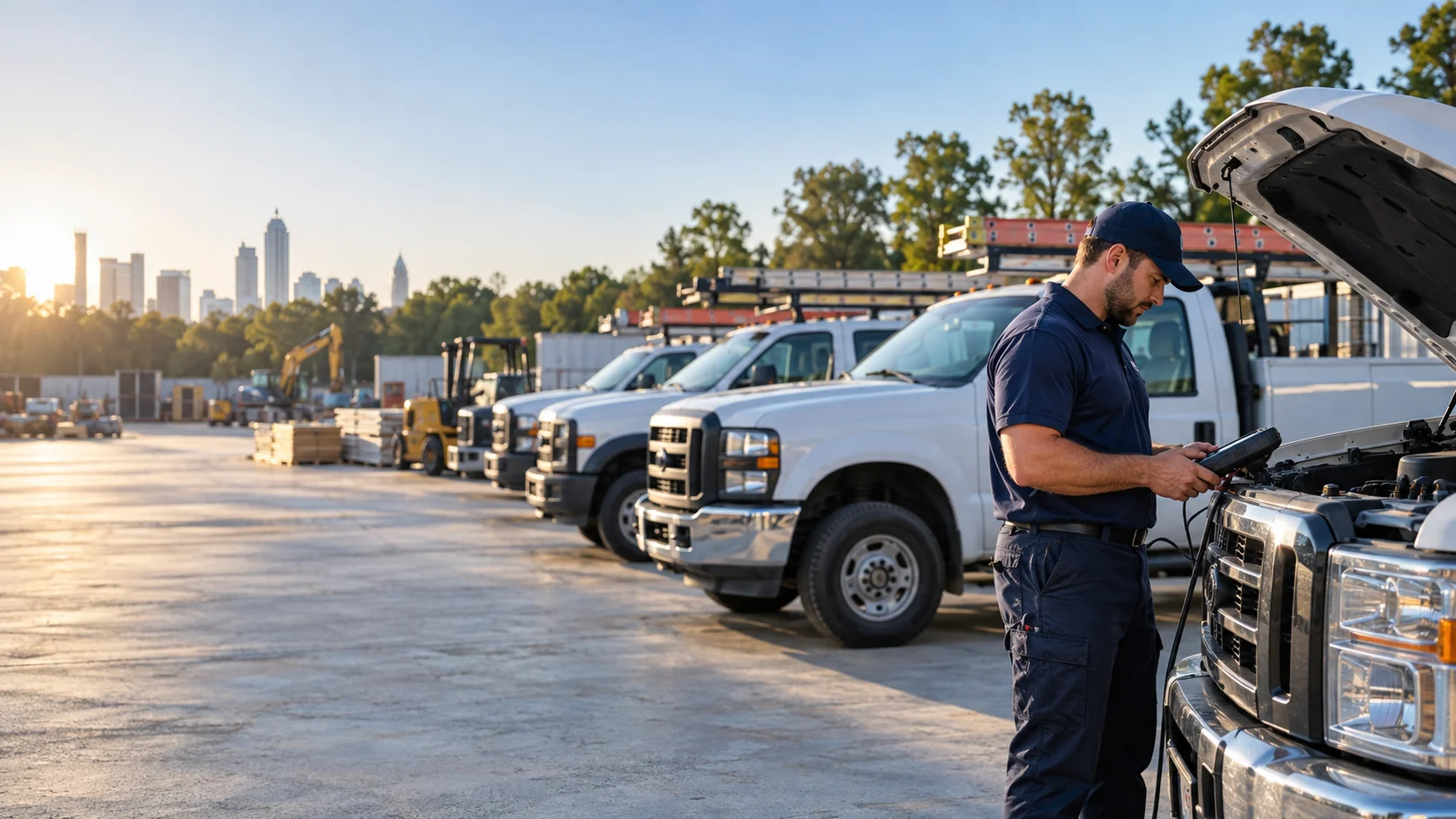
Mobile emissions testing solves the coordination problem directly. Instead of requiring every vehicle to be in one place, a certified mobile unit can test vehicles wherever they gather, whether that is a company yard, a shared morning meeting point, or a central office parking lot before technicians head out for the day.
The process is built to work with a scattered schedule:
- Share your list of vehicles coming due for testing and where they are typically parked or gathered
- Schedule a visit around a time when vehicles are naturally in one place, such as an early morning meeting or a yard where trucks are stored overnight
- We test the batch on site during that window
- Passing results are reported to the state the same day
- You receive one consolidated invoice at a flat $25 per vehicle, with no trip charges or hidden fees
Because testing happens wherever your vehicles naturally gather, technicians lose little to no time out of their workday, and the business avoids the disruption of sending trucks away one at a time.
Building emissions testing into a field service operation
Businesses that manage this well tend to build a few simple habits into how they run their fleet.
Centralise renewal tracking. Even if vehicles are decentralised day to day, keep a single list of every vehicle’s renewal date so nothing is tracked only in one technician’s head.
Find the natural gathering point. Identify whatever regular moment already brings vehicles together, whether that is a morning safety meeting, a shared yard, or an end-of-week check-in, and use that window for testing.
Batch by proximity or schedule, not by department. Group vehicles for testing based on when and where they are actually available, rather than trying to organise by role or crew.
Flag failures for fast repair. A failed vehicle takes a technician off the job until it is fixed, so routing it to repair immediately matters even more here than in a fleet with backup vehicles available.
Review the diesel and gasoline mix each year. As older diesel trucks are replaced or new gasoline vans are added, the share of the fleet that actually needs testing can shift meaningfully.
Frequently asked questions
Can you test vehicles that do not return to a central lot every day? Yes. We can schedule around whatever moment your vehicles naturally gather, such as a morning meeting point or an overnight yard, rather than requiring a dedicated trip.
Can you test our whole fleet in one visit? Yes. We handle everything from a handful of trucks to a large field service fleet in one scheduled visit, with one consolidated invoice.
How fast are results available? We post passing results to the state the same day, so a technician’s truck can return to service without delay.
Do diesel work trucks need testing? No. Diesel-powered vehicles are exempt from Georgia’s emissions testing program.
Do you serve businesses with technicians spread across multiple counties? Yes. We cover all 13 counties in the metro Atlanta emissions region, so we can reach vehicles wherever they work in the metro.
What happens if a truck fails while a technician needs it for the day? You are notified immediately with the reason for the failure, so you can arrange a backup vehicle or reschedule that day’s jobs while the repair happens.
Is the price really flat regardless of fleet size? Yes. It is $25 per vehicle whether we test five trucks or fifty, with no trip charges and no hidden fees.
Keep your technicians working, not waiting
A field service business cannot afford a technician sitting idle because their truck is stuck at a testing station. With on-site testing, vehicles get tested wherever they naturally gather, and technicians stay on the job.
Call (470) 669-0240 to schedule emissions testing anywhere in metro Atlanta. Flat $25 per vehicle, tested where you gather, with same-day reporting to the state.