Emissions Testing for Rental and Leasing Fleets in Atlanta: The Complete Guide
Rental and leasing companies run on vehicle availability. Every car sitting in a testing line cannot be rented, leased, or turned over to the next customer. In metro Atlanta, most gasoline vehicles need an annual emissions test to stay registered, which puts rental and leasing fleets in a tricky spot. The vehicles that make the most money are exactly the ones that keep coming due for testing, on a schedule that rarely lines up with when they are sitting still.
This guide covers everything a rental or leasing company in Atlanta needs to know about emissions compliance, why it hits this industry differently than a typical fleet, and how to keep vehicles turning over without the downtime that traditional testing creates.
Why rental and leasing fleets face a unique challenge
A typical corporate or delivery fleet vehicle sits in one place most of the time, parked at a depot overnight and driven on a predictable route. A rental or leasing vehicle rarely behaves that way. It moves between renters, between locations, and often between counties within the same week. That constant movement makes it far harder to build testing into a simple routine.
It also means a vehicle can come due for renewal at the worst possible moment, often while it is out with a customer, mid-lease, or about to be assigned to the next reservation. Unlike a fleet vehicle, you can pull off a route on your own schedule; a rental or leased vehicle’s availability is dictated by demand, not by your compliance calendar.
Add a large and constantly turning inventory on top of that, and a rental or leasing company can end up juggling dozens of testing deadlines at once, each running on its own independent clock.
Which vehicles need testing
Most gasoline vehicles registered in the 13-county Metro Atlanta emissions region need an annual passing test before their registration can be renewed. For a rental or leasing fleet, that generally covers the bulk of the gasoline inventory. A few categories are exempt:
- The three newest model years, a window that shifts forward every year
- Vehicles 25 model years old and older, which is rare in most rental and leasing fleets
- Diesel-powered vehicles
- Fully electric vehicles
Because rental and leasing fleets tend to run newer vehicles, a meaningful share of the fleet may fall under the newest model year exemption at any given time. That exemption window moves every year, so it is worth checking annually rather than assuming last year’s exempt vehicles are still exempt this year. A vehicle that was exempt twelve months ago may need its first test this cycle.
The cost of downtime in a rental or leasing business
For most businesses, a day of downtime is a lost day of productivity somewhere in the background. For a rental or leasing company, a day of downtime is a day of lost direct revenue, since an untested vehicle with a lapsed registration cannot legally go out to the next customer.
Sending vehicles to a testing station compounds the problem in a way that is specific to this industry. Someone has to pull the vehicle out of available inventory, drive it to a station, wait in line, and drive it back. During that entire window, a vehicle that could be earning rental or lease revenue is instead sitting still, doing nothing. Multiply that across a fleet that turns over constantly, with new vehicles cycling in and out every week, and the lost revenue days add up quickly, often faster than fleet managers realize until they actually total the hours.
How the timing problem compounds across a large fleet
The scheduling challenge is not just that vehicles move around. It is that renewal dates are spread unevenly across a fleet that was acquired in batches over time. A company that bought fifteen vehicles in one quarter and twenty in another ends up with two separate clusters of renewal dates, and every new acquisition adds another cluster. Without a system to track this, testing becomes a constant trickle of individual errands rather than a manageable, predictable task.
This is where many rental and leasing operations lose the most time. Not because any single test is difficult, but because the deadlines never stop arriving, one or two at a time, each one interrupting whatever else the team was doing that day.
How on-site testing fits a rental or leasing operation
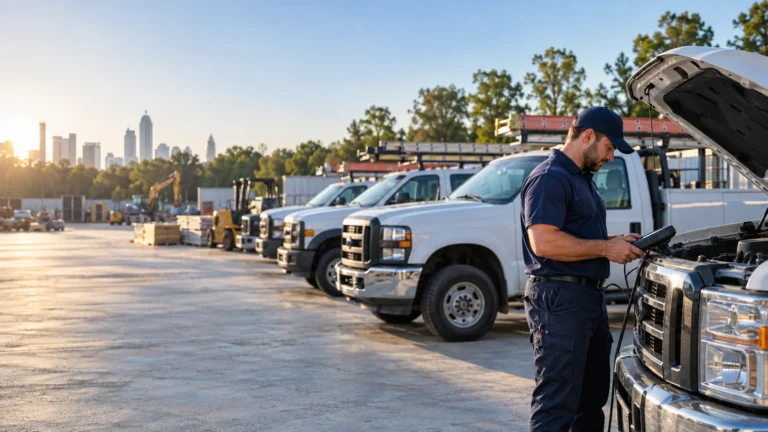
Mobile emissions testing solves the core problem directly. Instead of pulling a vehicle out of rotation to send it somewhere else, a certified mobile unit comes to your lot and tests it right there. The vehicle barely leaves availability at all, and in many cases can be tested during the normal turnaround window between one renter and the next.
The process is built to move at the pace this industry actually runs at:
- Share your list of vehicles due for testing and where they are currently parked.
- Schedule a visit that fits around your turnover schedule, not the other way around.
- We test the batch on site, including vehicles that are between rentals or leases.
- Passing results are reported to the state the same day.
- You receive one consolidated invoice at a flat $25 per vehicle, with no trip charges or hidden fees.
Because testing happens where your vehicles already are, you can time visits around natural gaps in your inventory, such as vehicles sitting between rentals, without disrupting active leases or upcoming reservations.
Building emissions testing into fleet turnover
The rental and leasing operations that manage this best treat testing as part of vehicle turnover, not as a separate compliance task bolted onto the side of the business. A few habits make this easier.
Track renewal dates alongside booking data. Keep each vehicle’s registration renewal date visible next to its rental or lease schedule, not in a separate system nobody checks regularly.
Flag vehicles early. Identify vehicles approaching renewal a few weeks out, so there is time to slot them into a natural gap in bookings instead of scrambling at the deadline.
Batch testing visits. Group several vehicles that happen to be between rentals at the same time into a single scheduled visit, rather than treating every vehicle as its own separate errand.
Keep documentation with the vehicle file. Store testing records alongside each vehicle’s maintenance and booking history, so compliance status is always a quick check rather than a search.
Review exemptions every year. Since the newest model year exemption shifts annually, recheck which vehicles in your fleet are currently exempt rather than relying on last year’s list.
This turns emissions testing from a recurring interruption into a step that happens quietly in the background of normal fleet turnover, the same way routine maintenance does.
What makes this different from managing a standard fleet
A standard corporate or service fleet manager can often predict exactly where a vehicle will be on a given day. A rental or leasing fleet manager usually cannot, since vehicle location depends on customer demand rather than a fixed route. That unpredictability is the single biggest reason generic fleet advice does not fully apply here.
The practical answer is flexibility on the provider’s side rather than rigid scheduling on yours. A testing partner that can adjust to short notice, work around whichever vehicles happen to be on the lot on a given day, and handle uneven batch sizes fits this industry far better than a fixed appointment system built for a fleet that never moves.
Frequently asked questions
Can you test vehicles that are only available for a short window between rentals? Yes. Because we test on site, we can work around short availability windows more easily than a station ever could, since there is no travel time involved on either end.
Can you test our entire fleet in one visit? Yes. We handle everything from a handful of vehicles to a large fleet in one scheduled visit, with one consolidated invoice.
How fast are results available? Passing results are posted to the state the same day, so a vehicle can go back into rotation without delay.
Do you cover multiple locations across metro Atlanta? Yes. We serve all 13 counties in the metro Atlanta emissions region, so we can reach vehicles across different lots or branches.
What happens if a vehicle fails while it is between rentals? You are notified immediately with the reason for the failure, so the vehicle can go to repair before its next scheduled booking instead of being assigned to a customer with an expired test.
Is the price really flat regardless of fleet size? Yes. It is $25 per vehicle whether we test five vehicles or fifty, with no trip charges and no hidden fees.
How do we know which of our vehicles are currently exempt? The three newest model years, vehicles 25 model years old and older, diesel vehicles, and fully electric vehicles are generally exempt. Since the model year window shifts every year, it is worth reviewing your fleet list annually.
Keep your fleet earning, not waiting.
In a rental or leasing business, every vehicle sitting in a testing line is a vehicle not making money. With on-site testing, your fleet stays where it is, gets tested quickly around your actual schedule, and goes right back into rotation.
Call (470) 669-0240 to schedule emissions testing at your lot anywhere in metro Atlanta. Flat $25 per vehicle, tested where you park, with same-day reporting to the state.